Locust Swarm and Agricultural Pest Early Detection

Identify locust swarm activity from satellite vegetation damage signatures before ground teams confirm. Klarety agents process high-frequency Sentinel-2 time-series to detect anomalous vegetation loss consistent with pest defoliation, then generate region-level alert packages for spray campaign coordination.

Early pest detection from vegetation damage signatures

Klarety AI
Klarety AI chat composer interface

Pest alert packages from satellite vegetation data

Klarety agents detect anomalous vegetation loss in Sentinel-2 time-series and return region-level pest alert reports.
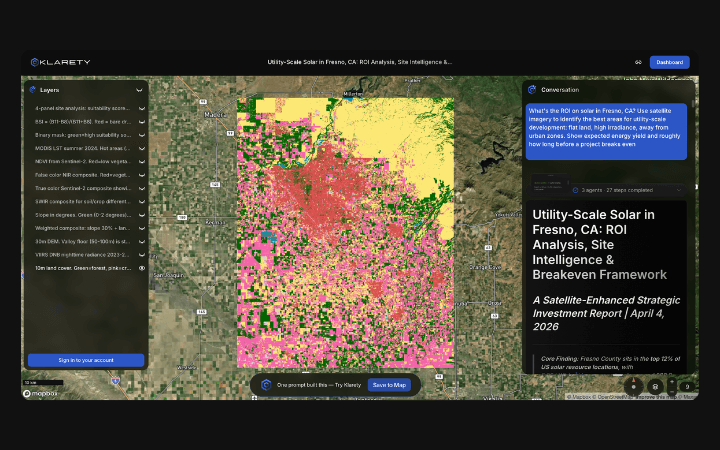
NDVI - Sentinel-2
Klarety satellite analysis output

High-frequency defoliation signature detection

Agents compare rolling NDVI composites to flag sudden vegetation loss inconsistent with seasonal growth patterns.
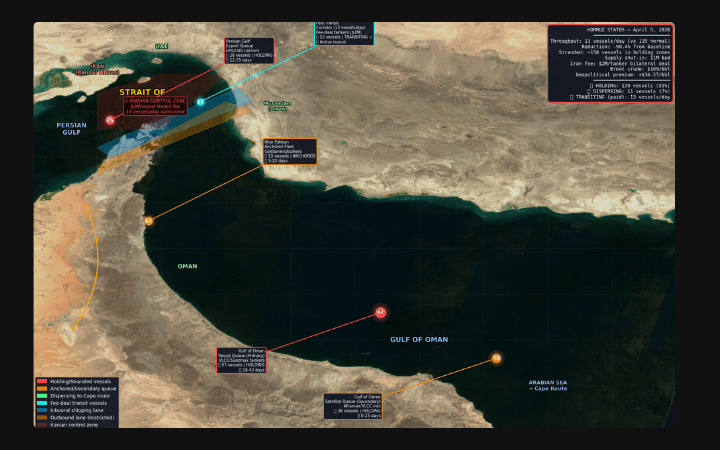
GIS Output
Klarety AI map annotation overlay

Defoliation vectors for agricultural response GIS

Export defoliation event polygons with severity scores for spray campaign planning and FAO early warning system integration.

Rapid NDVI defoliation detection for locust alerts

Klarety agents compute 10-day NDVI composites from Sentinel-2, detect pixels with NDVI drops exceeding 2 standard deviations of inter-annual variability in a 2-week window, and classify events by spatial pattern — locust swarm signatures show clustered, irregular defoliation distinct from drought patterns. Output is an alert polygon GeoJSON with affected area, severity, and onset date.

Klarety AISet up locust early warning for your region
analysis/locust_defoliation_alert.pyAgent code
python
import eeimport numpy as npfrom datetime import datetime, timedelta
ee.Initialize()
# East Africa locust monitoring zoneaoi = ee.Geometry.Rectangle([40.0, 2.0, 44.0, 6.0])
def ndvi_composite(start, end):    return (ee.ImageCollection('COPERNICUS/S2_SR_HARMONIZED')            .filterBounds(aoi)            .filterDate(start, end)            .filter(ee.Filter.lt('CLOUDY_PIXEL_PERCENTAGE', 25))            .map(lambda img: img.normalizedDifference(['B8','B4']).rename('ndvi'))            .mean())
# Build 5-year inter-annual variability baseline (same 10-day window)baseline_years = [2020, 2021, 2022, 2023, 2024]target_window = ('04-01', '04-10')  # 10-day window to monitor
baseline_imgs = [ndvi_composite(f'{y}-{target_window[0]}', f'{y}-{target_window[1]}')                 for y in baseline_years]baseline_coll = ee.ImageCollection(baseline_imgs)ndvi_baseline_mean = baseline_coll.mean().rename('ndvi_mean')ndvi_baseline_std  = baseline_coll.reduce(ee.Reducer.stdDev()).rename('ndvi_std')
# Current 10-day windowcurrent = ndvi_composite('2026-04-01', '2026-04-10')
# Anomaly z-scorez_score = ndvi_baseline_mean.subtract(current).divide(ndvi_baseline_std.add(0.01))
# Alert thresholdsalert_mask  = z_score.gt(2.0).rename('defoliation_alert')severe_mask = z_score.gt(3.0).rename('severe_defoliation')
alert_area = alert_mask.multiply(ee.Image.pixelArea()).reduceRegion(    ee.Reducer.sum(), aoi, 10, maxPixels=1e9).get('defoliation_alert').getInfo()
severe_area = severe_mask.multiply(ee.Image.pixelArea()).reduceRegion(    ee.Reducer.sum(), aoi, 10, maxPixels=1e9).get('severe_defoliation').getInfo()
print(f"Alert area (z>2.0): {(alert_area or 0)/10000:.0f} ha")print(f"Severe area (z>3.0): {(severe_area or 0)/10000:.0f} ha")print(f"Alert onset: Apr 1-10, 2026")
output/locust_alert_report.mdOutput report
python
# Locust Defoliation Early Warning Report**AOI:** East Africa monitoring zone (40-44°E, 2-6°N)**Window:** Apr 1-10, 2026 | **Source:** Sentinel-2 SR NDVI anomaly
## Alert Summary| Severity     | Z-Score | Area (ha) | Onset       | Status      ||--------------|---------|-----------|-------------|-------------|| Alert        | >2.0    | 41,200    | Apr 1-3     | ACTIVE      || Severe       | >3.0    | 18,700    | Apr 4-6     | URGENT      |
## Cluster Analysis- **Cluster 1:** 41.8°E, 4.2°N — 9,400 ha, irregular patch pattern- **Cluster 2:** 42.3°E, 3.7°N — 7,800 ha, radial spread from core- **Cluster 3:** 43.1°E, 4.8°N — 1,500 ha, linear corridor pattern
## Defoliation Pattern Classification- Pattern: **Irregular clustered** — consistent with locust swarm- Rate: NDVI -0.38 avg drop in 10 days — too rapid for drought- Spatial: multi-focal spread pattern, not single drought front
## Recommended Response- Ground verification: Clusters 1 and 2 within 48h- Pre-position aerial spray: coverage for 18,700 ha severe zone- FAO RAMSES alert: forward coordinates to regional bureaus
## MethodsSentinel-2 SR 10m. NDVI anomaly vs 5-year inter-annual baseline.Z-score >2.0 = defoliation alert. Pattern analysis: spatial clustering.Confidence: Medium (satellite detection; ground confirmation needed).

Try Klarety now.