

The disruption is here, and slowly, the rest of America and the world are starting to realize it.
The frontier labs are building intelligent models capable of generating virtually any software you can imagine. Naturally, that raises a question: what happens to the rest of us when software itself becomes a commodity?
I think we're asking the wrong question.
There are some key indicators that even OpenAI understands it's not as simple as having Codex, in all its glory and capability, wipe the floor with existing software solutions. OpenAI is taking steps to put developers directly in front of small businesses across America, helping them build bespoke software with its development tools and introducing them to operational AI agents like Dots.
Why is this happening if OpenAI and Anthropic are supposedly destined to take over it all?
Because AI, even with all its coding might, still needs to engage with the real world.
Software Is Changing, Not Disappearing
At a fundamental level, software serves two primary purposes in business: helping us understand what's happening and enabling us to do something about it. Analytics and operations.
SaaS solutions have historically provided interfaces for aggregating and analyzing data while establishing digital processes and protocols for running businesses.
Now, AI coding harnesses and agents are fundamentally changing the economics of software development.
But that's not the full story. Just like everything else, there are things in the middle and around the edges that give the story its color.
Some really smart early adopters are already seeing the value of being able to build their own software without the traditional background of a software engineer.
But for those of you who actually know how to design, architect and build software, you know that these AI tools are making you a superhero.
You're able to do more, build more sophisticated systems, tackle more complex problems and, quite frankly, run circles around your newfound, self-proclaimed software developer cohorts.
And THIS is a good thing for everybody.
It's almost as if the world just introduced the automatic transmission, but for software. Actually, that's a bit of a cop-out analogy. It's more like giving anyone who wants a car a car. They still have to figure out how to gas it up, where to go, how to get there and what to do when they arrive.
Software engineers will continue to demonstrate their value. The organizations that recognize this will be the ones capable of tackling some of the most demanding problems in their respective fields.
But here's the crux of it: software engineers and subject matter experts will still need each other. It's just that now, together, they can do so much more.
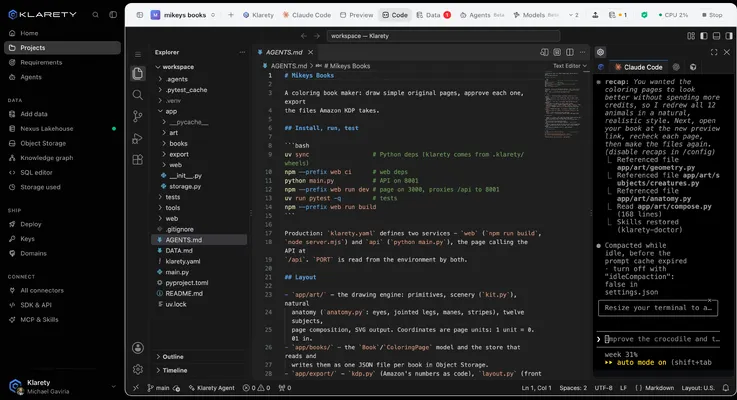
From Software as a Service to Agents That Serve
The current movement in AI is toward operational agents that automate the mundane tasks consuming people's time.
We're seeing the concept of personal assistants emerge through a number of products. Some are doing it better than others, and frankly, it's a fantastic movement in the space.
But it's just another step toward the enhancement and automation of operations across an entire economy.
SaaS is not dead…yet. But Agents as a Service will pull at a much deeper thread than data, access to infrastructure and the digital systems we use to run our businesses.
The agents of the future will take over portions of your business, at least as much as you're willing to let them and whatever parts are digital in nature. They'll continuously analyze what's happening, make decisions within established boundaries, execute tasks, evaluate outcomes and do work for you while you sleep.
We'll see really talented entrepreneurs take full advantage of these technologies to become more efficient, generate greater returns on their investments and reduce operational costs traditionally associated with paying humans to perform tasks that AI can now handle.
This is a different kind of business intelligence, and it will shape the future of the American and global economy.
So, there you have it. The next step is agents that serve.
Oh, but there's a catch.
Humans still matter.
The Human Intelligence Loop
We've been around for a while. Over that time, some pretty remarkable humans have established world-class frameworks for running businesses, leading organizations, and solving incredibly complex problems.
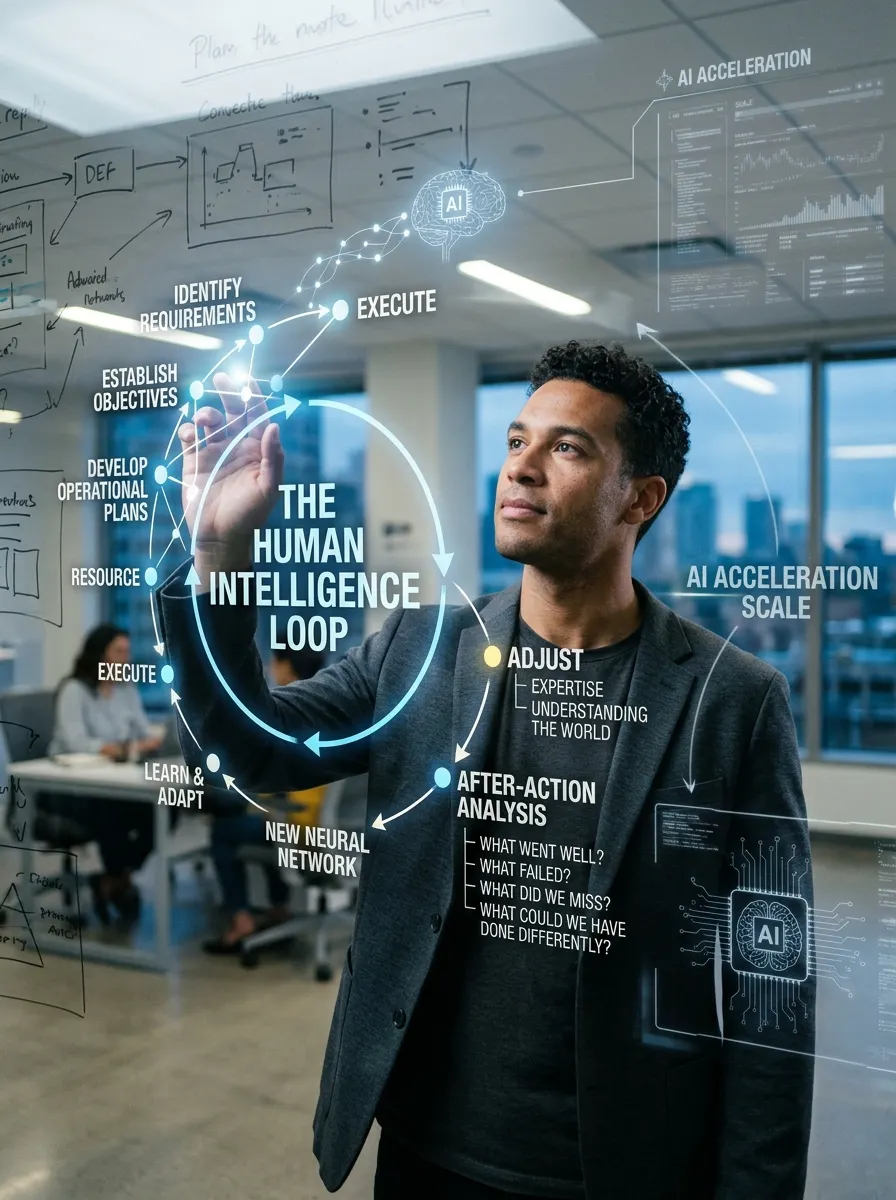
We identify requirements, establish objectives, develop operational plans, resource those plans, organize our people and go out to execute.
And guess what? The world gets a say in how all of that turns out.
As a leader, you adjust.
You adjust based on your expertise, your understanding of the environment and whatever the world has thrown at you.
When the operation is complete, or you've decided to abandon it, you conduct an after-action analysis.
What went well? What failed? What did we miss? What could we have done differently?
THIS is one of the most critical portions of the journey.
You take that knowledge and, in a sense, establish a new version of your own neural network as you prepare for the next endeavor. You learn, adapt and become better.
And all of this could be happening across multiple situations simultaneously, each with varying degrees of complexity, physical risk, monetary risk, and risk to human capital.
We've been running continuous intelligence loops long before we had artificial intelligence.
AI gives us the ability to accelerate those loops, operate more of them simultaneously and process information at a scale that was previously unimaginable.
But having the intelligence to execute doesn't necessarily mean having the wisdom to determine what should be executed in the first place.
Lest we forget the subject matter expertise you've accumulated over the course of your life. That expertise, coupled with the frameworks you've developed to succeed in your field, will be amplified by AI.
But you must continue to lead.
The Next Economy Is an Expertise Economy
THIS, seriously, this time, is where I believe the future is going.
For decades, software has been one of the primary mechanisms through which we've distributed human expertise at scale.
Think about it. Behind virtually every meaningful piece of business software is someone who understood a problem well enough to establish a methodology for solving it. Software engineers then translated that methodology into something thousands of other people could use.
We've been packaging human expertise inside software and selling access to it.
But what happens when building the software itself is no longer the biggest barrier to entry?
What happens when we can separate the expertise from the software that contains it?
Consider the business owner who has spent 35 years learning how to successfully operate a company. What happens to that expertise when they retire or sell their business to someone from a younger generation?
The new owner acquires the equipment, employees, contracts, customers and financial records. But do they acquire 35 years of judgment?
Consider the engineer who understands why certain systems fail, the farmer who understands the nuances of growing crops in a particular environment or the entrepreneur who has developed a methodology for building successful businesses.
How much of that expertise is lost simply because we've never had an effective mechanism to capture, operationalize and redistribute it?
Historically, the economic reach of human expertise has largely been constrained by time. You could consult, teach, write a book or build a software company. All valuable endeavors, but each with its own limitations.
What if someone could take 30 years of professional experience and turn it into an asset that continuously generates value for thousands of businesses without having to physically be there?
Not just telling those businesses what to do, but actually helping them do it.
I see three economic models emerging alongside one another, each representing a shift in where value is created and how it's delivered:
- Software as a Service (SaaS): Access to the tools that enable you to do the work. This is the model that has defined the software economy for the past two decades. It remains relevant today, but its economics are being fundamentally disrupted by AI.
- Agents as a Service (AaaS): Access to intelligence that performs the work. This is happening right now. We're moving from paying for the tools that enable humans to perform tasks to paying for intelligence that can perform those tasks on our behalf. This transition is already reshaping the software industry.
- Expertise as a Service (EaaS): Access to the accumulated human knowledge, judgment and methodologies that inform how the work should be performed. This is where I believe the future is going. As software becomes increasingly commoditized and agents become increasingly capable, the value shifts toward the specialized expertise that guides their decisions, informs their actions and determines what success looks like.
These models won't necessarily replace one another. They'll coexist, but the center of economic value will shift.
SaaS gave us the tools. AaaS gives us the workforce. EaaS will give that workforce the benefit of generations of human expertise.
Imagine a world where a business owner can acquire the expertise of someone who has spent decades mastering a particular industry, combine it with their own business data and have AI continuously apply that expertise within their organization.
Maybe there's an application. Maybe there isn't. Maybe the expertise operates quietly in the background, helping the business owner make better decisions and execute more effectively.
The application becomes secondary. The agent becomes the mechanism for execution. The expertise becomes the product.
That's a fundamentally different economic model.

But We Have to Get the Economics Right
People aren't going to willingly surrender the expertise that makes them valuable if doing so ultimately makes them less valuable.
Why would an employee teach an AI everything they know if the outcome is losing their job? Why would a successful entrepreneur distribute the methodology that gives their business a competitive advantage? Why would a consultant give away the intellectual property they've spent decades developing?
These are legitimate questions.
We need to create an economy where people can retain ownership of their expertise, control how it's distributed, and participate in the economic value it creates.
A retiring professional should have the opportunity to continue earning from decades of experience. A younger entrepreneur should be able to build upon the knowledge of those who came before them. Someone in a developing country should be able to commercialize their expertise globally without having to leave their home or raise millions of dollars to build a software company.
We should be extending the economic reach of human intelligence, not simply extracting it.
If we get this right, we could create an entirely new class of entrepreneurs. People whose greatest assets aren't their ability to write software or their access to capital, but their knowledge, experience and ability to solve real-world problems.
Don't Lose Your Humanity
As software becomes increasingly commoditized, I believe human expertise, judgment, creativity and our ability to navigate the complexities of the real world will become increasingly valuable.
The ones and zeros will become easier to produce. Knowing what to do with them is an entirely different story.
How we capture, preserve, operationalize and redistribute human expertise could lead to a new economic revolution and accelerate the advancement of science, technology, engineering, mathematics and business.
Imagine generations building upon the accumulated expertise of previous generations at a scale we've never experienced before.
Perhaps the greatest irony of the AI revolution is that we'll eventually look back and realize that artificial intelligence forced us to better understand and appreciate the value of human intelligence.
Don't lose your humanity on a path enabled by AI.
Lean into your human mind, your curiosity, your creativity, your judgment and the experiences that make you uniquely valuable.
Go create amazing things.
AI is the propellant. Humanity is the driving force.
Check us out at klarety.ai.