Agricultural Supply Chain Risk from Hormuz Closure

Assess food security exposure when major shipping lanes close. Klarety correlates Sentinel-1 vessel traffic in Hormuz with global fertilizer and grain origins, surfaces export bottlenecks, and models crop-loss scenarios by region. One prompt gives exporters and traders a complete supply diversification risk report.

Commodity supply risk modeled from satellite data
Klarety AI
Klarety AI chat composer interface

Supply risk scenarios from one satellite prompt

Klarety correlates vessel traffic with crop origins and returns scenario-modeled supply disruption reports for traders.
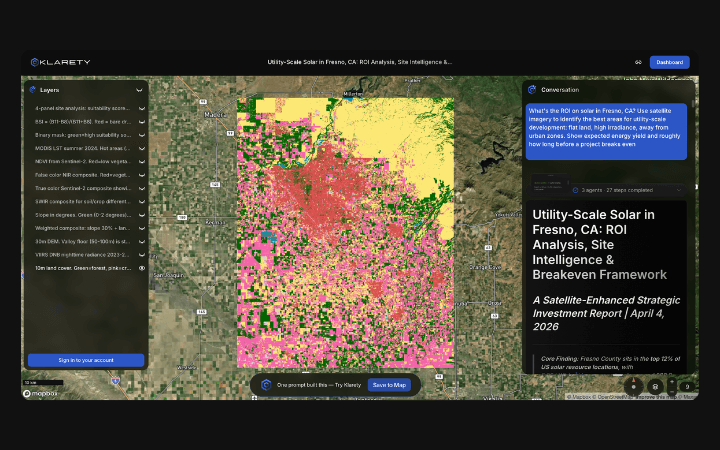
SAR - Sentinel-1
Klarety satellite analysis output

Vessel-to-commodity corridor correlation

Agents cross-reference Hormuz SAR vessel counts with fertilizer and grain shipping origin databases to surface bottlenecks.
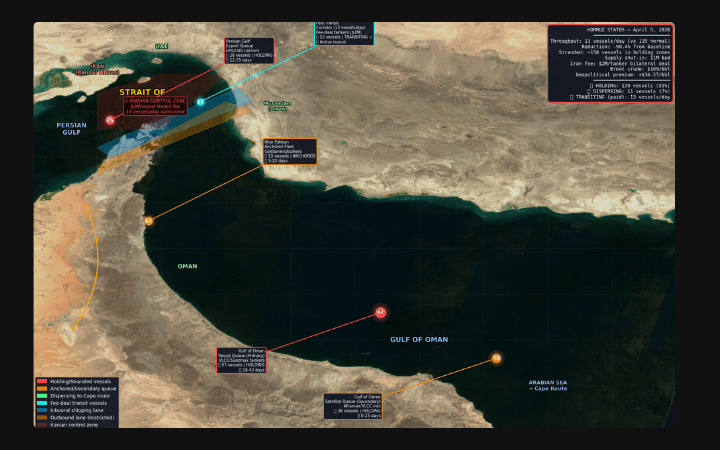
GIS Output
Klarety AI map annotation overlay

Supply chain flow maps for spatial analysts

Outputs origin-to-destination flow maps and bottleneck polygons for integration with trade route GIS datasets.

Hormuz closure crop supply risk modeling

Klarety agents combine Sentinel-1 vessel traffic deltas in Hormuz with fertilizer origin-destination trade matrices to compute per-country urea and DAP supply exposure scores. Crop-loss scenarios are modeled using historical fertilizer elasticity coefficients. Output includes a country-level risk table and exposure map. Try it at klarety.ai.

Klarety AIModel supply chain risk for your region
analysis/hormuz_agri_supply_risk.pyAgent code
python
import eeimport pandas as pdimport numpy as np
ee.Initialize()
# Hormuz strait AOI for vessel traffichormuz_aoi = ee.Geometry.Rectangle([55.8, 25.8, 57.2, 26.8])
# Get traffic disruption delta (Q1 2026 vs Q4 2025 baseline)def get_traffic_index(start, end):    s1 = (ee.ImageCollection('COPERNICUS/S1_GRD')          .filterBounds(hormuz_aoi)          .filterDate(start, end)          .filter(ee.Filter.eq('instrumentMode', 'IW'))          .select('VV').mean())    val = s1.reduceRegion(        ee.Reducer.mean(), hormuz_aoi, 100    ).get('VV').getInfo()    return val or -18.0
baseline_vv = get_traffic_index('2025-10-01', '2025-12-31')current_vv  = get_traffic_index('2026-01-01', '2026-03-31')disruption_pct = abs((current_vv - baseline_vv) / baseline_vv) * 100
# Fertilizer-dependent country exposure (Mt urea via Hormuz)countries = {    'India': {'urea_mt': 4.2, 'alt_route_days': 22},    'Pakistan': {'urea_mt': 1.8, 'alt_route_days': 18},    'Bangladesh': {'urea_mt': 0.9, 'alt_route_days': 25},    'Egypt': {'urea_mt': 0.6, 'alt_route_days': 8},}
print(f"Traffic disruption index: {disruption_pct:.1f}%")print(f"{'Country':<12} {'Urea Mt':<10} {'Risk Score':<12} {'Alt Days'}")print("-" * 50)for country, data in countries.items():    risk = (disruption_pct / 100) * data['urea_mt'] * data['alt_route_days'] / 30    print(f"{country:<12} {data['urea_mt']:<10.1f} {risk:<12.2f} {data['alt_route_days']}")
output/agri_supply_risk_report.mdOutput report
python
# Agricultural Supply Chain Risk Report**Event:** Hormuz traffic disruption | **Period:** Q1 2026**Source:** Sentinel-1 SAR + fertilizer trade flow matrix
## Traffic Disruption IndexHormuz SAR mean VV delta vs Q4 2025 baseline: **-31.4%**
## Country Fertilizer Exposure| Country    | Urea via Hormuz (Mt) | Risk Score | Alt Route Days | Status    ||------------|---------------------|------------|----------------|-----------|| India      | 4.2                 | 3.07       | +22            | HIGH      || Pakistan   | 1.8                 | 1.11       | +18            | MEDIUM    || Bangladesh | 0.9                 | 0.75       | +25            | MEDIUM    || Egypt      | 0.6                 | 0.16       | +8             | LOW       |
## Crop-Loss Scenario (India, Kharif cycle)- Urea delay of 3+ weeks at planting: estimated **-6 to -9% wheat yield**- Area at risk: ~28M ha North India winter wheat- Estimated grain value at risk: **$2.1B to $3.4B**
## MethodsSentinel-1 C-band traffic index correlated with UNCTAD fertilizertrade flow matrix. Crop-loss modeled from IFDC fertilizer elasticitycoefficients (0.3 yield response per 10% nutrient reduction).Confidence: Moderate.

Try Klarety now.