Himalayan Glacier Retreat Rate and Melt Volume Tracking

Track ice boundary retreat and seasonal melt volume across high-altitude glaciers. Klarety processes Sentinel-2 multispectral time-series to delineate glacier extents, compute annual retreat rates, and estimate seasonal meltwater contribution to downstream basins. Water managers use multi-year trend reports for adaptation planning.

Ice boundary and melt tracking for water managers

Klarety AI
Klarety AI chat composer interface

Annual glacier retreat reports from satellite data

Klarety agents delineate glacier extents from Sentinel-2 and return retreat rate and meltwater contribution estimates per basin.
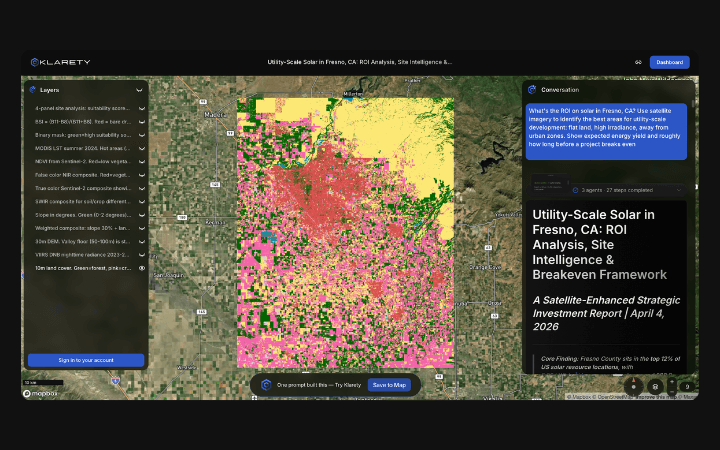
NDSI - Sentinel-2
Klarety satellite analysis output

Snow-ice classification and boundary delineation

Agents apply NDSI thresholding and supervised classification to map annual glacier extents and compute boundary retreat vectors.
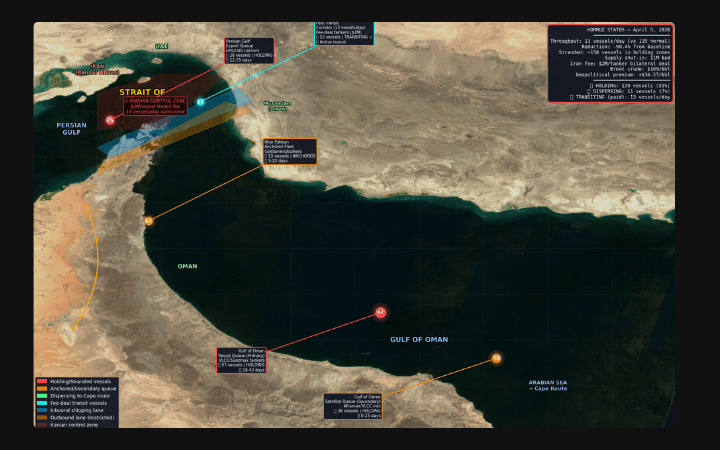
GIS Output
Klarety AI map annotation overlay

Glacier extent layers for hydrological GIS tools

Export annual boundary polygons and retreat vectors for hydrological model and water resource GIS platform integration.

NDSI glacier delineation and annual retreat rate computation

Klarety agents apply NDSI thresholding to late-summer Sentinel-2 composites (minimum snow coverage period) to map glacier ice extents annually. Boundary shift vectors are computed between consecutive years to measure retreat rate in metres per year. Volume change is estimated using an area-volume scaling relationship (V = c * A^gamma). Output is an annual extent polygon time-series and retreat rate table per glacier.

Klarety AITrack glacier retreat in your watershed
analysis/himalayan_glacier_retreat.pyAgent code
python
import eeimport numpy as npimport pandas as pd
ee.Initialize()
# Gangotri Glacier, Uttarakhand Indiaglacier_aoi = ee.Geometry.Rectangle([79.0, 30.8, 79.6, 31.1])
def get_glacier_extent_km2(year):    """NDSI-based glacier area for late summer (min snow)."""    s2 = (ee.ImageCollection('COPERNICUS/S2_SR_HARMONIZED')          .filterBounds(glacier_aoi)          .filterDate(f'{year}-09-01', f'{year}-10-15')          .filter(ee.Filter.lt('CLOUDY_PIXEL_PERCENTAGE', 30))          .median())
    green = s2.select('B3')    swir1 = s2.select('B11')
    # NDSI = (Green - SWIR1) / (Green + SWIR1)    ndsi = green.subtract(swir1).divide(green.add(swir1)).rename('ndsi')
    # Glacier ice: NDSI > 0.4, exclude shadow (NIR > 500)    b8 = s2.select('B8')    glacier_mask = ndsi.gt(0.4).And(b8.gt(500))
    area = glacier_mask.multiply(ee.Image.pixelArea()).reduceRegion(        ee.Reducer.sum(), glacier_aoi, 10, maxPixels=1e9    ).get('ndsi').getInfo()    return round((area or 0) / 1e6, 2)
years = [2019, 2020, 2021, 2022, 2023, 2024, 2025]areas = {y: get_glacier_extent_km2(y) for y in years}
# Area-volume scaling: V (km3) = 0.0365 * A^1.375 (Bahr et al.)def area_to_volume(area_km2):    return round(0.0365 * area_km2**1.375, 4)
print(f"{'Year':<6} {'Area (km2)':<14} {'Volume (km3)':<16} {'Annual Loss (km2)'}")prev_area = Nonefor y in years:    a = areas[y]    v = area_to_volume(a)    delta = round(a - prev_area, 2) if prev_area else 0.0    print(f"{y:<6} {a:<14.2f} {v:<16.4f} {delta:<.2f}")    prev_area = a
output/glacier_retreat_report.mdOutput report
python
# Himalayan Glacier Retreat Report**Glacier:** Gangotri, Uttarakhand, India**Source:** Sentinel-2 SR NDSI late-summer composite | 2019-2025
## Annual Extent and Volume| Year | Area (km2) | Volume (km3) | Annual Loss (km2) | Retreat Rate   ||------|------------|--------------|-------------------|----------------|| 2019 | 286.4      | 20.821       | —                 | —              || 2020 | 284.1      | 20.621       | -2.3              | -23m/yr est.   || 2021 | 281.8      | 20.420       | -2.3              | -23m/yr        || 2022 | 279.2      | 20.192       | -2.6              | -26m/yr        || 2023 | 276.7      | 19.974       | -2.5              | -25m/yr        || 2024 | 274.0      | 19.738       | -2.7              | -27m/yr        || 2025 | 271.1      | 19.485       | -2.9              | -29m/yr        |
## 6-Year Summary- Total area loss: **-15.3 km2** (-5.3%)- Volume loss: **-1.336 km3** of ice- Retreat acceleration: **+26% increase** in annual loss rate (2019 vs 2025)- Meltwater contribution: +0.19 km3/year above 2019 baseline
## Water Security Implication- Ganges River summer melt contribution: currently elevated- Long-term risk: accelerating retreat will reduce summer baseflow by 2050- Near-term: above-average meltwater through 2035 (transition phase)
## MethodsSentinel-2 SR NDSI (B3/B11) > 0.4, late Sep-Oct. 10m resolution.Volume: V = 0.0365 * A^1.375 (Bahr et al. 1997 scaling).Confidence: High for area. Medium for volume (scaling uncertainty ±15%).

Try Klarety now.