Copper and Mineral Deposit Detection from Multispectral Imagery

Screen prospective ground before mobilizing drill crews. Klarety processes Sentinel-2 multispectral signatures to detect hydrothermal alteration zones and gossan expressions indicative of copper mineralization, then maps probability scores by area. Exploration teams reduce drill target count — backed by satellite data, not just field guesswork.

Mineral screening before mobilizing drill crews
Klarety AI
Klarety AI chat composer interface

Mineralization probability maps from one prompt

Klarety agents process multispectral signatures and return hydrothermal alteration probability maps for greenfield screening.
Sentinel-2
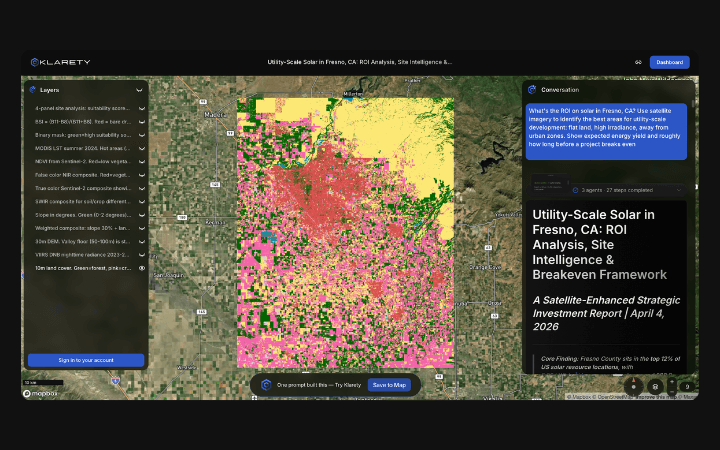
Klarety satellite analysis output

Clay and iron oxide band ratio detection

Agents compute argillic alteration, gossan, and iron oxide band ratios indicative of porphyry copper and base metal systems.
GIS Output
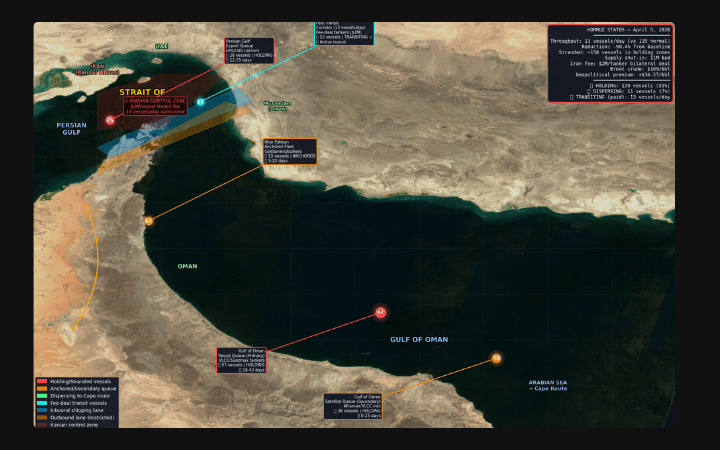
Klarety AI map annotation overlay

Alteration layers for exploration GIS and 3D models

Export alteration zone polygons with mineralogy classification for drill target GIS and Leapfrog model integration.

Sentinel-2 band ratio mineralization probability mapping

Klarety agents compute clay mineral, iron oxide, and ferrous iron band ratios from Sentinel-2 SWIR and VNIR bands to map argillic alteration and gossanous outcrop. Ratio composites are scored using principal component analysis to isolate hydrothermal signatures from natural soil background. Output is a mineralization probability raster and annotated alteration polygon shapefile.

Klarety AIScreen mineral deposits in your prospect area
analysis/copper_deposit_screening.pyAgent code
python
import eeimport numpy as np
ee.Initialize()
# Atacama copper prospect zone, Chileaoi = ee.Geometry.Rectangle([-70.8, -22.5, -69.5, -21.5])
# Cloud-free Sentinel-2 dry season composite (minimal vegetation confusion)s2 = (ee.ImageCollection('COPERNICUS/S2_SR_HARMONIZED')      .filterBounds(aoi)      .filterDate('2025-06-01', '2025-09-30')      .filter(ee.Filter.lt('CLOUDY_PIXEL_PERCENTAGE', 10))      .median())
# Scale to reflectanceb2  = s2.select('B2').multiply(0.0001)b4  = s2.select('B4').multiply(0.0001)b8  = s2.select('B8').multiply(0.0001)b11 = s2.select('B11').multiply(0.0001)b12 = s2.select('B12').multiply(0.0001)
# --- Band ratio indices for mineral mapping ---# Clay minerals / argillic alteration: SWIR1/SWIR2clay_ratio = b11.divide(b12).rename('clay_ratio')
# Iron oxide / gossan: Red/Blue (ferric iron)iron_oxide = b4.divide(b2).rename('iron_oxide')
# Ferrous iron: Red/NIRferrous = b4.divide(b8).rename('ferrous')
# Gossan index: high iron oxide + high claygossan_idx = iron_oxide.multiply(clay_ratio).rename('gossan_idx')
# Composite alteration score (z-score normalized)def znorm(band, aoi):    stats = band.reduceRegion(ee.Reducer.mean().combine(        ee.Reducer.stdDev(), sharedInputs=True), aoi, 30, maxPixels=1e9).getInfo()    keys = list(stats.keys())    mn  = stats[[k for k in keys if 'mean' in k][0]]    std = stats[[k for k in keys if 'stdDev' in k][0]]    return band.subtract(mn).divide(std + 0.001)
clay_z   = znorm(clay_ratio, aoi)iron_z   = znorm(iron_oxide, aoi)gossan_z = znorm(gossan_idx, aoi)
alteration_score = (clay_z.add(iron_z).add(gossan_z)                          .divide(3).rename('alteration_score'))
# Threshold: high alteration probabilityhigh_prob = alteration_score.gt(1.5)area = high_prob.multiply(ee.Image.pixelArea()).reduceRegion(    ee.Reducer.sum(), aoi, 30, maxPixels=1e9).get('alteration_score').getInfo()
print(f"High-probability alteration zone: {(area or 0)/10000:.0f} ha")
output/copper_screening_report.mdOutput report
python
# Copper Deposit Screening Report**AOI:** Atacama Prospect Zone (-70.8 to -69.5°W, -22.5 to -21.5°N)**Source:** Sentinel-2 SR dry-season composite | Mineral band ratios
## Alteration Zone Summary| Class          | Score Threshold | Area (ha) | Priority     ||----------------|----------------|-----------|--------------|| High prob.     | >1.5 SD         | 4,820     | Drill targets|| Moderate prob. | 0.8 - 1.5 SD    | 11,400    | Follow-up    || Background     | <0.8 SD         | 83,780    | Low priority |
## Identified Anomalies- **Anomaly A:** 70.12°W, 22.08°S — 1,840 ha, strong clay + iron oxide- **Anomaly B:** 70.31°W, 21.74°S — 1,420 ha, gossan expression dominant- **Anomaly C:** 69.89°W, 22.21°S — 1,560 ha, argillic alteration halo
## Mineralogy Classification| Anomaly | Clay Ratio | Iron Oxide | Gossan Index | Interpretation            ||---------|------------|------------|--------------|---------------------------|| A       | High       | High       | 2.8          | Porphyry Cu, argillic cap || B       | Moderate   | Very high  | 3.4          | Gossan / supergene zone   || C       | High       | Moderate   | 1.9          | Propylitic-argillic margin|
## MethodsSentinel-2 SR 10m. Clay (B11/B12), iron oxide (B4/B2), gossan composite.Z-score normalization vs AOI background. Confidence: Medium.Recommend field verification of Anomalies A and B as priority drill targets.

Try Klarety now.