

Limits and rate limits
Read what your plan allows from code, and what happens when you reach a limit.
Your plan sets limits: calls per minute, how much a query may read, upload size, active and more. Read them from code so requests are right the first time.
Read your limits
In Python
from klarety import Nexus

with Nexus.connect() as nexus:
    limits = nexus.limits()
    print("Plan family:", limits.family)
    for knob in limits.knobs:
        value = knob.fixed if knob.fixed is not None else knob.default
        print(f"{knob.name}: {value} {knob.unit or ''}  ({knob.description})")
nexus.limits() returns a Limits object:
| Field | Meaning |
|---|---|
family | Your plan's family. |
knobs | Every limit, as a Knob. |
studio_sizes | Each size your plan offers, with cores and memory_gb. |
Find one limit by name with limits.knob("api_key.max_active"). It raises KeyError when there is no such limit.
What a knob holds
| Field | Meaning |
|---|---|
name | The limit's name. |
description | What it limits, in words. |
kind, unit | Its type and unit. |
fixed | The value, when your plan fixes it. |
default, minimum, maximum | The default and range, when a project may choose within it. |
choices | The allowed values, for a limit that is a choice. |
settable_on_project | Whether a project may set its own value. |
Over HTTP
GET/v1/limits
curl -s https://api.klarety.ai/v1/limits -H "Authorization: Bearer $TOKEN"In the app
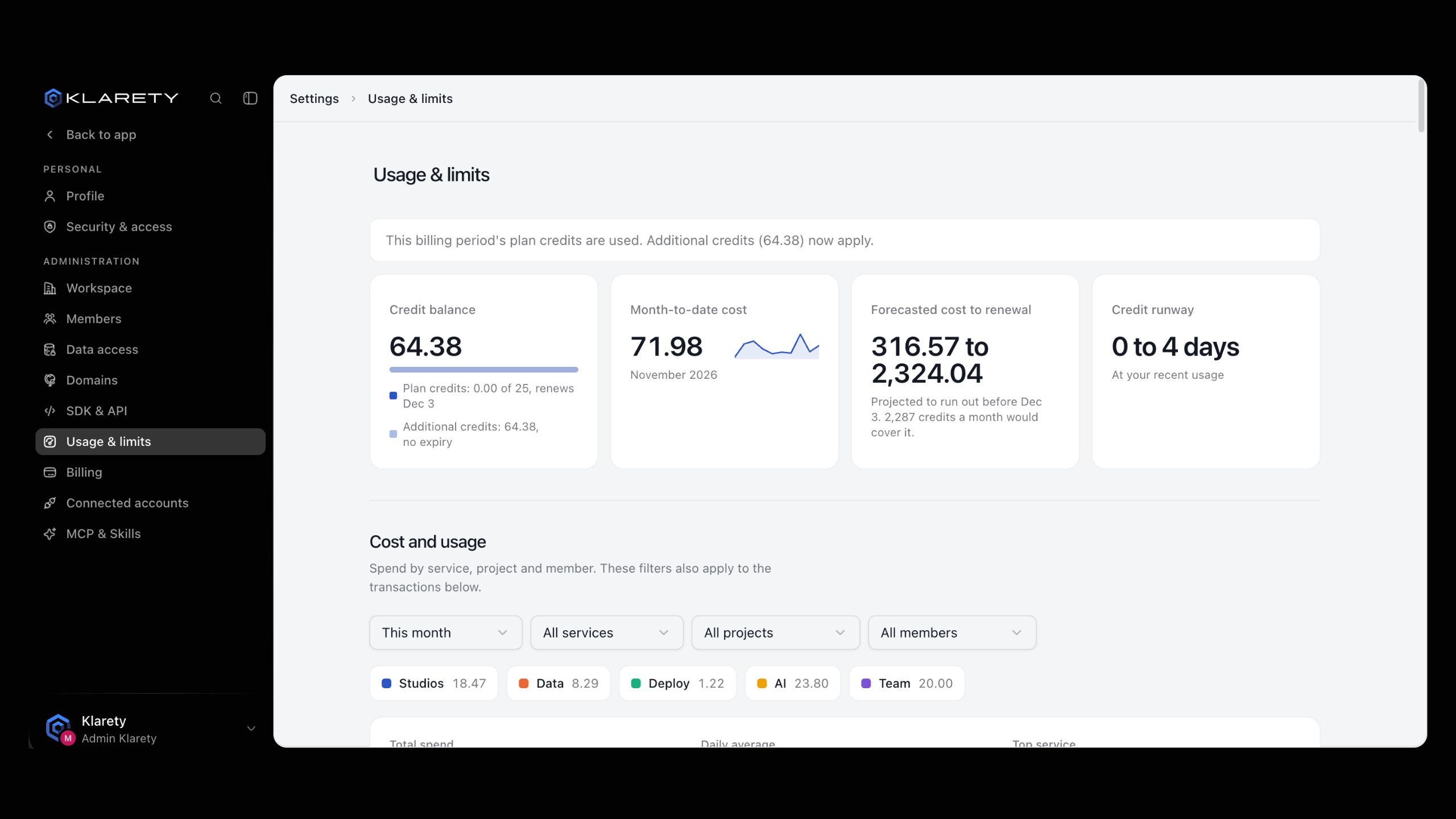
Open SettingsUsage & limits to see your , spend and plan limits.
A description, not a promise
limits() describes your plan. The server still checks every request, so handle refusals anyway.
Fixed limits
These are the same on every plan:
| Limit | Value |
|---|---|
| Request body | 1 MiB. Larger data goes through an upload, not the request. |
| Upload link | Lasts one hour. |
max_rows on a SQL statement | 1 to 10,000, and never more than your plan's page of rows. |
| SQL parameters | Up to 256 per statement. |
Rows changed by one edit_rows() | Up to 500. |
| Statements in one batch job | 1 to 50. |
Edges sent in one assert_edges() | Up to 1,000. |
When you reach a limit
| What happens | Status | SDK exception | What to do |
|---|---|---|---|
| Too many calls per minute | 429 with Retry-After | RateLimitedError | The SDK waits and retries. Slow your loop down. |
| Every statement slot busy | 429 | OverBudgetError | The SDK waits and retries. Send it again later. |
| A query would read too much | 413 | OverBudgetError | Narrow it; check with nexus.estimate(). |
| Body over 1 MiB | 413 | OverBudgetError | Send less, or upload a file. |
| Out of credits | 402 | InsufficientCreditsError | Add credits. |
| Another plan limit | 403 or 422 | RefusedError | The error's limit field names it. |
A refusing limit is named in the error's limit field, so you can ask for it to be raised. See Errors.
Next steps
- Errors for the full error format.
- Run SQL to estimate a query before you run it.
- Authentication to manage active keys.